
Reaction Time Test
Reaction Time Test
What the reaction time test measures
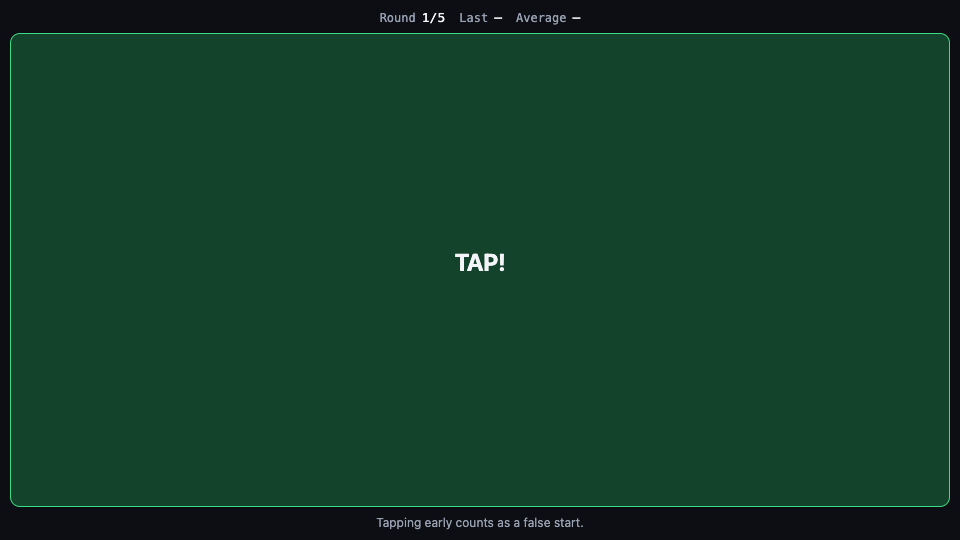
This test measures one specific thing: the time between a visual signal appearing and you acting on it. You press play, the frame stays dark, and at an unpredictable moment it turns green. The gap between green appearing and your tap is your reaction time for that round, recorded in milliseconds. Five rounds later the page gives you one average.
It is deliberately narrow. There is no memory component, no decision to make and no penalty for being slow, so what you are left with is the raw loop of seeing and moving.
How to play
Press Play Reaction Time Test to open the game in the frame at the top of this page. Tap anywhere in the frame once to start the first round. The frame will hold a dark colour for a random moment; when it turns green, tap as fast as you can.
If you tap before the green appears, the frame turns red and reads Too soon. That round is thrown out and you tap again to retry it. This is why the test asks for five rounds: one tap can be a guess, five taps are harder to fake.
When the fifth round is done, the frame shows your average in milliseconds. Tapping again starts a fresh set of five.
Reading your score
The average is the number that matters. A single fast tap can come from anticipating the flash rather than reacting to it, and a single slow tap can come from a notification sliding across your screen. Averaging five rounds removes most of that noise.
A lower number is better. Results depend on the device, the input method and how tired you are. What the test gives you is a repeatable baseline: play five rounds now, five rounds tomorrow, and compare your own two averages.
Why your numbers move
Several things change your time between runs, and only some of them are about you:
- Anticipation. If you start moving before the green arrives, you are measuring your guess, not your reflexes. Wait for the colour.
- Input lag. A touch screen, a wireless mouse and a trackpad respond differently. Their latency varies by device.
- Hardware load. Tabs playing video, downloads and updates all steal frames. Close them before a serious run.
- Warm-up. The first round of a session is often the slowest. Play one full set and then judge the second set.
- Tiredness and light. Late-night runs in a bright room tend to be slower than daytime runs in normal light.
Tips for a clean time
Rest your finger or cursor in the middle of the frame rather than at the edge, so the distance to the target area does not depend on where you happened to land. Keep your hand and the phone on a stable surface. When the signal appears, click, tap or use the focused play-area button with the keyboard.
And do not chase a single number. The reason this page runs five rounds is that the average is a much better description of your reflexes than your best tap of the day.
More from the court
All gamesFrequently asked questions
How many rounds does the test run?
Five. The page reports your average across all five rounds, not your fastest single tap.
What happens if I tap too early?
The frame turns red and says Too soon. That round does not count, and you tap again to retry it, so a guess cannot lower your average.
Can I compare a phone score with a mouse score?
They use different input hardware and can respond at different speeds. For a personal baseline, compare runs made with the same device and input method.
Is there a pass mark?
The game reports your average in milliseconds. Use repeated runs with the same setup to track your own result.
Can I play the reaction time test in fullscreen?
Yes, use the fullscreen button under the frame. Fullscreen also removes the browser toolbar, which keeps your attention on the frame instead of on the address bar.
What did you score? Share how your run went.